


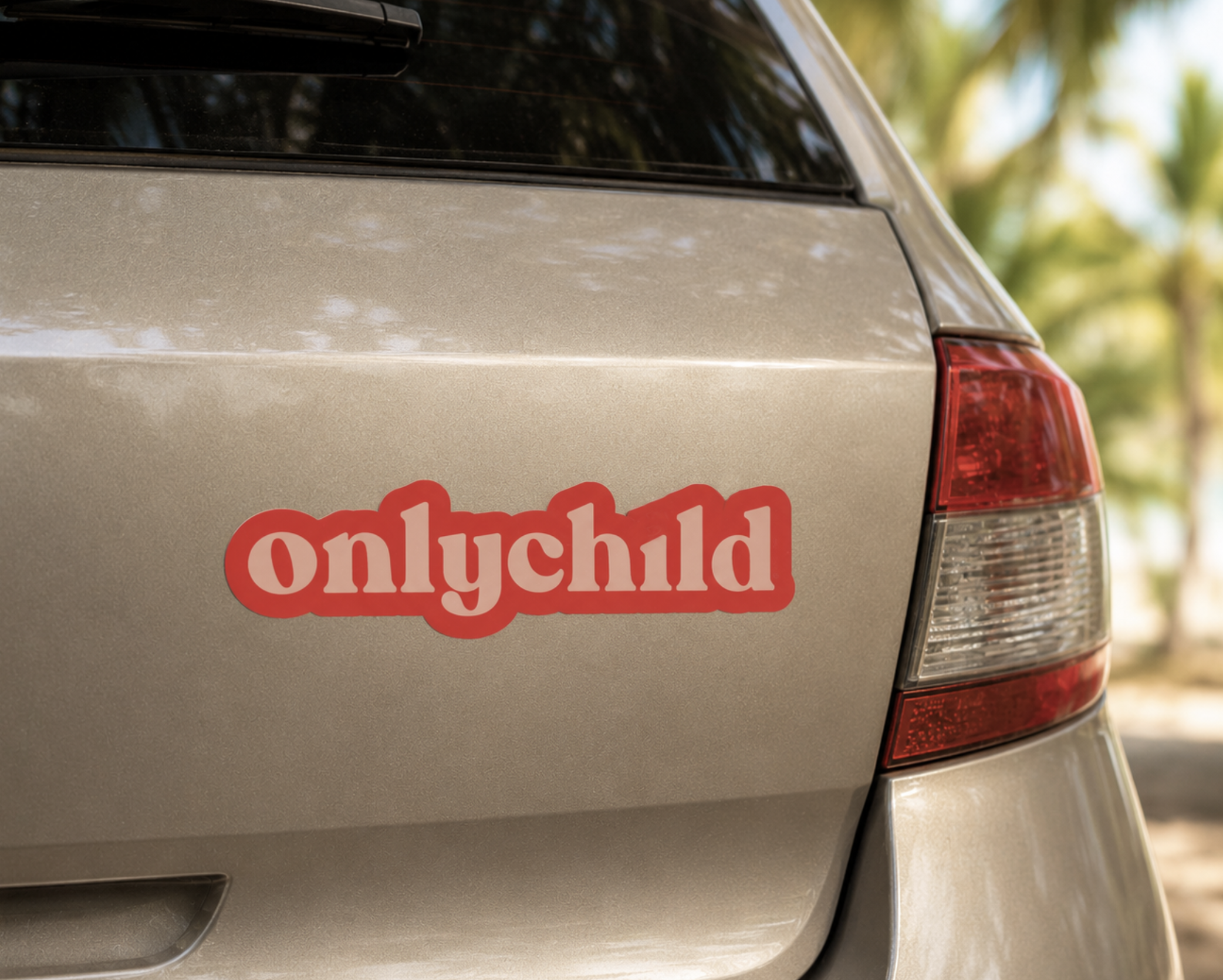
Seven years ago I printed the first Onlychild sticker. It was a Sticker Mule order, placed back when the studio was barely a studio and ordering stickers felt like a real commitment.
I took a handful home to Costa Rica and gave one to my best friend, Lucia. She put it on the back of her car.
Here is the part I did not plan for. She is not an only child. She has five siblings, and they have never let her forget it. For seven years she has been driving around with a sticker that announces something demonstrably untrue about her, getting teased for it at every family gathering. She kept it anyway. It became part of how her car looked, part of how people spotted her in a parking lot, part of her.
Recently she got a new car, her first in all that time. Before anything else, she texted me to ask if I could send another Onlychild sticker to Costa Rica.
A mark I designed seven years ago has been out in the world every single day since, on a car that belongs to someone who does not even fit the name, and it cost me one sticker. No ad I have ever paid for comes close to that.
I think about this every time a client asks how to make their brand feel real to people. Most brands we work with have spent serious money on a logo, a color system, a website, and a voice, and then the whole thing lives on a screen, seen at thumb speed between a friend's vacation photos and an ad for mattresses. Physical objects are the cheapest, longest-lasting brand impressions available to a small company, and giveaways are the fastest way to get them into the world.
Most giveaways are run badly, in a way that borrows attention instead of earning it. Here is how we think about doing it well.
Start with the object, not the offer
The instinct is to work backwards from the mechanic: we need followers, so what can we dangle? That produces a gift card, a bundle of things nobody chose, or a product the winner will resell.
Work forward from the object instead. Ask what small physical thing carries your brand honestly, and what someone would keep even if they had paid for it. Usually the answer is not expensive. A sticker with a line of copy only your people understand. A magnet a customer actually wants on a fridge she looks at forty times a day. A patch, a pin, a piece of packaging good enough that people photograph it before they open it.
The test we use with clients: would this thing survive a move? My friend's sticker survived an entire car. If it goes in a drawer, it was merch. If it goes on a laptop, a bumper, a water bottle, or a wall, it is a brand asset that keeps working for years without another dollar of spend.
That standard is also a design brief. Small objects are unforgiving. There is no room for a tagline, a mission statement, and three colors. You get one idea, executed with confidence. Founders often find that designing a two-inch sticker clarifies the whole brand.
Give people a reason to enter that is not a lottery ticket
A giveaway that asks for nothing but a follow will collect people who follow giveaways. They are real accounts and worthless audience. Six weeks later your engagement rate is lower than when you started.
Make the entry itself a filter. Ask for an email so you own the relationship instead of renting it from an algorithm. Attach the giveaway to something with context: a launch, a milestone, a collaboration with a founder your people already trust. Ten entries from people who care beat a thousand from people who do not, and the ten are the only ones who will ever buy anything.
This is where a lot of women-led brands have an advantage they do not use. If you have built an actual community, a giveaway is not a growth hack, it is a party favor. Run it that way. Say who it is for. Let everyone else scroll past without guilt.
Make the logistics somebody else's problem
The reason most small teams run one giveaway and never again is not strategy. It is the shipping.
Picking a winner fairly, collecting an address, packing, postage, tracking, answering the message that says it never arrived: it is a week of somebody's attention for what was supposed to be a marketing afternoon. Founders quietly decide it was not worth it, and a good channel gets abandoned for operational reasons.
This is why we point clients toward Sticker Mule Give. You choose a product you have already ordered or pick one from their marketplace, set how many winners you want, decide how people enter (email, or engagement on X), and share the link. Give draws the winners and ships the prizes for you. You can also set it up as a raffle where everyone wins, which is closer to how we would use it for a community moment or a small list you want to treat well.
No landing page, no form, no spreadsheet of addresses, no trip to the post office. The whole thing becomes a link you can drop in a newsletter or a story. That turns giveaways from a once-a-year production into something you can do on a Tuesday because you felt like it.
Measure the thing that actually matters
Entries are a vanity number. Track these instead:
Emails collected, and what they do next. The open rate on your first campaign after the giveaway tells you whether you attracted your people or a crowd.
Cost per retained follower, not per entry. Divide by the people still around in ninety days.
Sightings in the wild. Photos of your object on somebody's laptop, cooler, or bumper are the actual return, and they compound. Ask winners to tag you and keep the images. That is a year of social content you did not have to art direct.
Generosity is a position, not a tactic
The brands that do this well are not being clever. They are being generous in a way that matches what they already say about themselves, and the giveaway is just the delivery mechanism.
If your brand claims to be built around a community, the way you give things away should look like a gift, not a toll booth. Fewer hoops, clearer language, a real reason, something worth keeping. Do that consistently and the objects go do something no ad can: they sit in people's homes, on their laptops, on the back of their cars, quietly making the case for you for years.
I am mailing a sticker to Costa Rica this week. Seven years in, it is still the best marketing money I have ever spent.
Onlychild is a branding and design studio working with companies building for women. If you are thinking about merch, packaging, or the physical side of your brand, say hello.
